 |
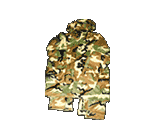
The IRS parka and trousers are made of a pliable, moisture vapor semipermeable polyurethane coated nylon with a durable water-repellant finish. The parka will accept the standard button-in field jacket liner for additional insulation. The trousers have slide-fastener, adjustable-closure, bottom leg hems for easier donning and doffing without removal of boots.
Weight: 2.9 pounds
|
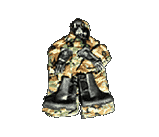 |
This ensemble is a lightweight, flexible clothing system that provides protection against chemical and biological agents. The components, when combined with standard CB protective butyl gloves and masks for respiratory protection, allow for complete mission-oriented protective posture flexibility.
Weight: 9.6 pounds
|
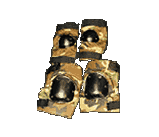 |
Knee and elbow pads provide protection to dismounted soldiers engaged in tasks that subject these areas to possible injury. The pads are constructed of a molded, high-density polyethylene shell fastened to a camouflage fabric outer cover that is sewn to a polyester inner lining. Inside the covering is sewn a three-segment impact-cushioning polyethylene foam.
Weight: 1.7 pounds
|
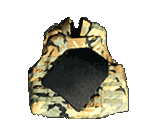 |
The Interceptor system was designed to provide effective defense against shrapnel from mines, grenades, artillery fire, mortar shells and rifle bullets. The IBA system consists of a Kevlar vest with detachable neck and groin guards, and small-arms protective inserts.
Weight: 16.4 pounds
|
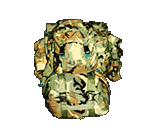 |
The MOLLE system consists of a modular rucksack with removable compartments and components, and a fighting load vest that accepts removable pockets for rifle, pistol, squad automatic weapon and grenadier configurations. It also includes an On-the-Move Hydration System.
Weight: 16.8 pounds
|
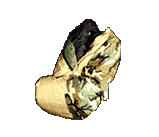 |
The MSBS is a bag-within-a-bag concept. An intermediate sleeping bag fits into a “patrol” warm-weather bag to form an extreme cold-weather sleeping bag. The MSBS consists of a camouflage, water resistant, breathable bivouac cover; a lightweight patrol sleeping bag; an intermediate cold-weather sleeping bag; and a compression stuff sack (to store and carry the system).
Protection: Patrol Bag: 35 to 50 degrees
Intermediate CW Bag: -5 to 35 degrees.
Patrol, ICW and ECWCS: Down to -50 degrees.
Weight: 10.6 pounds
|
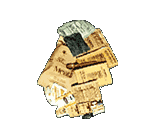 |
The standard military ration for the individual soldier is the MRE. Each MRE contains approximately 1,300 calories. The MRE remains usable for three years at 80 degrees and six months at 100 degrees. Since 1993, 70 new items have been approved for the MRE, 14 of the least popular items were replaced, menus increased from 12 to 24, and four vegetarian meals are now included.
Weight: 1.5 pounds
|
 |
The standard PASGT helmet was first fielded in the early 1980s. The helmet, available in five sizes, provides ballistic protection to the head from fragmenting munitions. It is a one-piece structure composed of multiple layers of Kevlar 29 ballistic fabric and phenolic/PVB resin.
Weight: 3.1 pounds (X-Small) 4.2 pounds (X-Large)
|
|
The M-9 multipurpose bayonet system is used as a bayonet on the M-16- series rifle and the M-4-series carbine, as a hand weapon, as a general field and utility knife, as a wirecutter together with its scabbard, and as a saw.
|
|
This helmet-mounted image-intensification system is used for such night time operations as driving, walking, map reading and performing maintenance. The system is designed for use in conjunction with rifle mounted aiming lights.
Weight: 1.5 pounds
Range: 150 meters (man-size target in starlight)
350 meters (quarter moon)
Field of view: 40 degrees
Magnification: 1x
Power: Two AA batteries or one lithium battery.
|
|
The Soldier Intercom allows soldiers to talk to each other from up to 700 meters without giving away their positions. Squad leaders can talk to the entire squad simultaneously on a discreet channel heard only by them. Each SI unit includes a receiver/transmitter, rechargeable battery pack and headset with boom microphone.
Weight: 1.4 pounds
|
|
The M-4 is a more compact, four-position buttstock version of the M-16A2 rifle.
Caliber: 5.56mm
Magazine capacity: 30 rounds
Overall length (compact): 29.8 inches
|
|
The M-40 mask protects soldiers against nuclear, biological and chemical threats by filtering air through an externally mounted filter canister. The canister is easy to replace and can be mounted on the left or right side of the mask. The M-40 is used in conjunction with the Joint Service Lightweight Integrated Suit Technology ensemble to allow for complete mission-oriented protective posture.
Weight: 4.5 pounds
|
|
This four-color, woodland-camouflage pattern uniform is intended for use in temperate-zone combat, field and garrison environments. The coat is a “bush”-type design with breast and lower pockets with flaps. The trousers have four standard pockets, two with flaps, and two leg-cargo pockets with flaps. The cloth is 50 percent cotton, 49 percent nylon and one percent static dissipative fiber.
Weight: 3.1 pounds
|
|
Combat boots are worn in combat, field and garrison environments that don’t require specialized footwear. The upper boot is made of cattlehide leather treated for mildew and water resistance. The boot has a lace-and-closed-loop closure system, padded collar and direct-molded sole with deep-lug tread design and a replaceable heel.
Weight: 4.1 pounds per pair (Size 9)
|
|
On-the-Move Hydration System
Fighting Load Vest
|